
Ancient Truths, Relevant Today
Classical Christian education is grounded in the belief that there is Truth to be known, goodness to be cultivated, and beauty worth pursuing.
This method of learning is time tested. It formed Augustine and Frederick Douglass, filled the cathedral schools and the early American academies, and has outlasted nearly every theory of education built to replace it. We teach classical education because it produces people who think deeply, speak clearly, and use their talents to serve the community.

Eva Thompson
Student
What We Believe
01
Education exists to pursue truth, wisdom, and virtue
Students learn to seek objective truth, apply knowledge wisely, and form virtuous habits that lead to a life of integrity and joy.
02
Learning should be joyful, and it should start in wonder
Learning is meant to be alive with discovery and delight. Joy and rigor belong together.
03
Every subject points to something larger than itself
All knowledge reveals God’s design. Science shows His order, art His beauty, history His providence, and language His Word.
01
Wisdom and eloquence
Students think clearly, reason soundly, and communicate truthfully.
02
Learning from the masters
Students engage with the best ideas, books, and creations throughout history.
03
Virtue through character development
Students study heroes of faith and history, practice daily virtue, and serve others so that wisdom becomes habit and love becomes action.
04
Loving God and neighbor
Christ is the Logos—the ordering Word of creation and model for living. Every subject ultimately points students toward worship, gratitude, and service.
01
Wonder and depth of understanding
Teachers invite students to ask not only how something works but why it exists and what it is for.
02
Socratic dialogue
Through guided discussion, students practice critical thinking, attentive listening, and intellectual humility.
03
Scholé: restful, contemplative learning
Education unfolds at a human pace—unhurried, reflective, joyful.
04
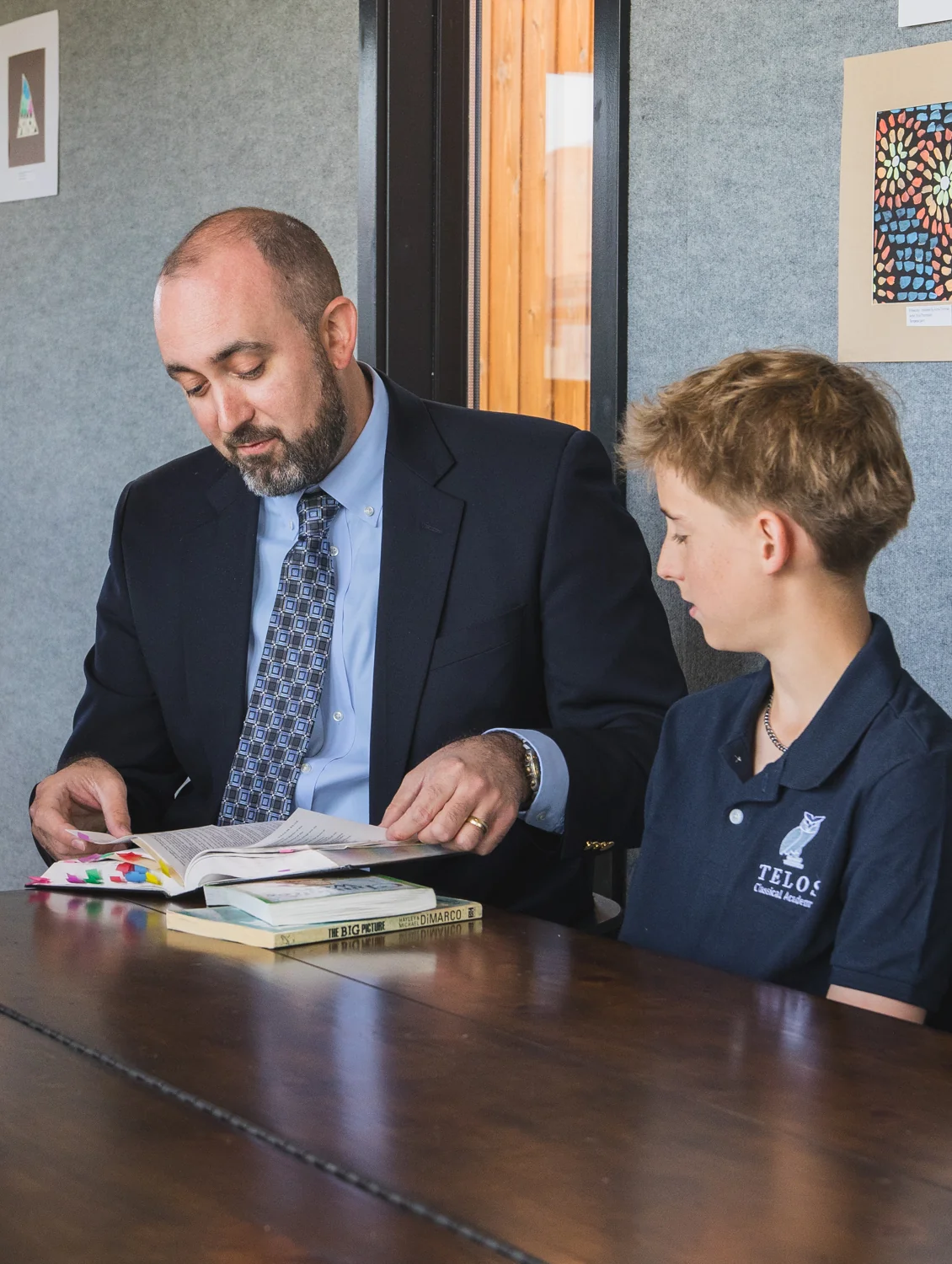
The teacher as mentor
Teachers embody wisdom and virtue, forming students through relationship and example.
Grammar, Logic, and Rhetoric are the three language liberal arts that teach a student to handle language with precision, reason with rigor, and speak with grace.

Christ is the Logos
Faith is woven through the culture of the classroom, in the way students are taught to speak to one another, in the questions they are encouraged to ask, and in the virtues they are called to practice. It provides a shared moral and spiritual framework—guiding students toward wisdom, humility, courage, and love of neighbor.